Open source · November 10, 2026
Receipts: making AI-written product docs show their evidence
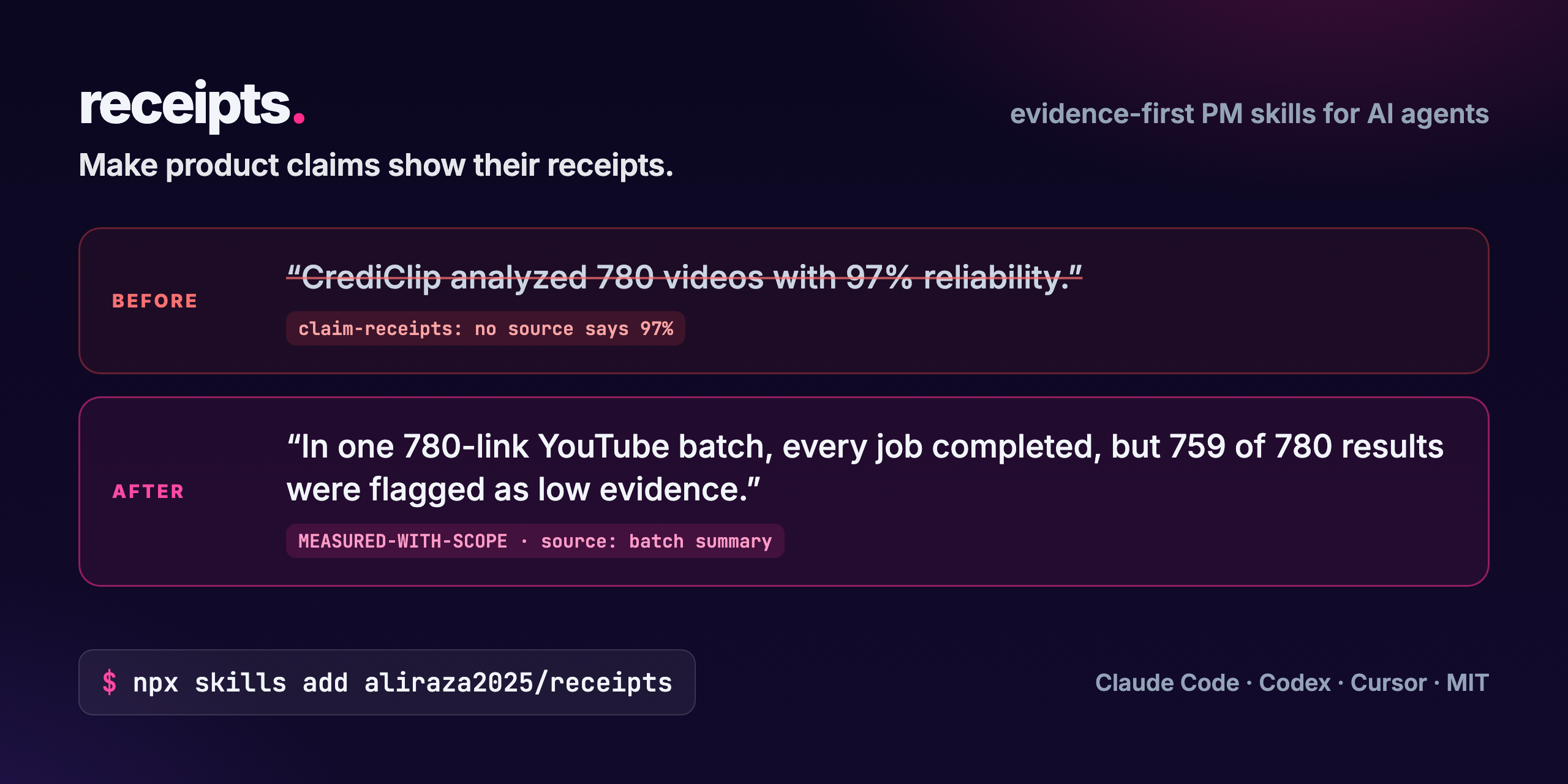
AI agents write PRDs and launch copy quickly, and they write unsupported claims just as quickly. Receipts is six open-source skills for Claude Code, Codex, and Cursor that make a product doc say where each claim comes from and what each number does not prove.
View the repository ↗ · Read the self-test ↗
The problem I kept running into
On CrediClip, one 780-link YouTube batch finished with every job completed. In the same batch, 759 of 780 results were flagged as low evidence. "All 780 jobs completed" was true and told a reader almost nothing about whether the product worked. I wrote about that gap in What 780 completed video jobs taught me about AI product quality.
AI writing tools make this gap easier to fall into. Ask an agent for a launch page or a metrics slide and it will produce fluent, confident sentences, including numbers and outcomes that no source supports. Those sentences then travel into decks, READMEs, and resumes.
What Receipts does
- claim-receipts labels every claim as sourced, needing scope, an assumption, or unsupported, and rewrites the weak ones.
- metric-receipts pairs each metric with the decision it informs and what it cannot prove.
- ai-eval-receipts writes readiness gates for an AI feature: did it run, did it have enough evidence, and did it agree with an independent judgment.
- experiment-receipts plans A/B tests decision first, with sample size labeled as a planning assumption.
- prd-receipts keeps what users said apart from what the team inferred or assumed.
- plain-copy removes filler and AI-sounding phrasing without adding claims.
Install with one command: npx skills add aliraza2025/receipts.
Design choices
- Rewrites only narrow. A skill may cut a claim, add its scope, or relabel it as an assumption. It may never add a number, customer, or outcome that a source does not contain.
- A small, fixed label set. Four labels are easy to scan in a review and hard to argue around.
- Examples are real or labeled. Every example is either sourced from my published work or marked as illustrative.
- Thresholds are product choices. The evaluation gates come from CrediClip's readiness benchmark, and the skill says plainly that teams should set their own before looking at results.
- Checked in CI. A validator checks each skill's metadata and file size and rejects em dashes, which the skills themselves treat as an AI-writing tell.
The self-test
Before launch, an AI agent ran claim-receipts on the repository's own README, using only the repo and the linked pages as sources. It checked eight claims and labeled one unsupported: the README said every claim on my portfolio has an entry on the Sources page. The Sources page actually lists primary sources by topic. The README now says that instead.
What it does not do
- It cannot verify a fact it was not given. It flags missing support; it does not find it.
- It does not replace labeled evaluation of an AI feature. It makes the absence of one visible.
- How and when each agent picks up a skill on its own varies. Naming the skill in a request is the most reliable trigger.
- It was released on November 10, 2026. There is no usage data yet.
Sources and ownership
Skills, examples, validator, and sample-size script by Ali Raza, with AI-assisted drafting. MIT licensed. The methods come from CrediClip, the Raasta experiment, requirements work on the Blue Ocean estimator, and this site's Sources page. Need this kind of rigor on a product? Work with me.